
Checking Williamson County Criminal History
Williamson County criminal history is split among several custodians, so the first step is to define the question. The Williamson County Circuit Clerk links the local case-information search and maintains the official court file. That source shows what prosecutors filed and what the judge decided. A sheriff or police report instead records the alleged event, while the jail records intake and custody. Illinois State Police supplies statewide conviction information and a separate fingerprint route for reviewing your own Illinois history.
Gather the full legal name, spelling variants, an approximate filing or arrest year, and a case or report number when known. Search results can contain people with similar names. Match a result through public case details rather than treating the name alone as proof. When a case is recent, allow for the time between arrest, charging review, and clerk filing.
- Open the clerk's official page and follow “View Williamson Co. Case Info” for filed local cases.
- Search the exact surname, add a first or middle name, then narrow by year or case type.
- Read the docket, charge counts, status, disposition, sentence, and financial entries as a whole.
- Ask the arresting agency for its incident report and the sheriff for releasable booking or custody data.
- Use the ISP route that fits the need: UCIA conviction information or fingerprint-based Access and Review for your own record.
Williamson Case Search Fields
The local case search offers more useful controls than a broad web search. Begin with a surname or a complete clerk-formatted case number. First name and middle initial help reduce false matches. A case-type filter separates criminal and traffic matters from other dockets, while filed-date fields help when a common name returns many entries. The interface may change because the clerk uses a participating court service, but the underlying file remains the clerk's record.
| Search field | Best use | Required |
|---|---|---|
| Last Name / Business Name | Primary name key; test lawful spelling variants | One search key |
| First and Middle Name | Narrow a common surname | Optional |
| Case Number | Reach a known file directly | Alternative key |
| Case Type | Limit results to criminal or traffic files | Optional |
| Filed From / To | Focus on a likely year range | Optional |
A docket description does not mean that every document image is online. Contact the clerk for a complaint, judgment, sentencing order, docket sheet, or certified copy. The clerk can provide records and procedure but cannot give legal advice.
Illinois Official Background Checks
The Illinois State Police Bureau of Identification separates public conviction inquiries from a person's review of their own fuller record. Under the Uniform Conviction Information Act, a public response contains conviction information reported to ISP. Electronic name inquiries cost $10 and paper name inquiries cost $16. The CHIRP electronic channel requires the applicable ISP agreement and digital authentication, so it should not be described as an anonymous public name-search box.
For self-review and correction, Access and Review uses fingerprints taken at an Illinois law-enforcement or correctional facility or by an Illinois-licensed live-scan vendor. ISP charges no processing fee for that product, although the fingerprint provider may charge for capture. ISP mails the transcript or no-record response to the subject and includes a Record Challenge form. The current licensed fingerprint-vendor list is the safe way to locate a provider because no permanent Williamson County vendor site was verified.
Williamson Record Check Costs
Fees depend on the product, not merely on whether a name or fingerprints are used. ISP processing and a live-scan vendor's capture service are separate charges. The ISP fee schedule controls the state amount. Local copy or certification costs were not verified in a current official Williamson County schedule, so ask the clerk or record holder before ordering.
| Official product | State fee | Extra condition |
|---|---|---|
| UCIA name inquiry, electronic | $10 | CHIRP authorization and authentication |
| UCIA name inquiry, paper | $16 | Form and mailing |
| UCIA fingerprint inquiry | $15 electronic / $20 paper | Capture fee is separate |
| State and FBI fee-applicant check | $27 electronic / $32 paper | Vendor charge may apply |
| Access and Review | $0 ISP fee | Fingerprint provider may charge |
| FBI Identity History Summary | $18 | Capture or channeler cost may be extra |
Criminal Record Types
A Williamson County criminal record is not one document. Each custodian records a different stage. Police create incident and arrest reports. Jail staff create booking and custody entries. The State's Attorney chooses the allegations placed in a complaint, information, or indictment. The circuit clerk then maintains docket events, orders, pleas, judgments, sentences, warrants, and payment entries. ISP assembles reportable fingerprint-supported events and later dispositions in the state repository.
Custody also divides by system. Williamson County jail data concerns local custody. The IDOC Individuals in Custody search covers state commitments, while the federal Bureau of Prisons locator covers federal custody such as FCI Marion. The ISP Sex Offender Registry is a distinct public-notification record, not a full criminal-history transcript.
- Arrest and booking records describe an allegation, intake, initial charges, holds, and release status.
- Criminal court files show charges filed, hearings, pleas, disposition, and sentence.
- ISP conviction responses provide the public conviction slice reported to the state repository.
- Warrant records can appear in court dockets and law-enforcement systems, with access limits for sealed or unserved matters.
- Supervision and registry records belong to the court, probation district, IDOC, review board, or registry custodian.
Williamson Jail Search Fallback
No stable official county inmate roster or daily booking log was verified. That absence calls for a source-by-source fallback, not a commercial mugshot gallery. Start with the Williamson County Sheriff and jail at 404 North Van Buren Street in Marion, (618) 997-6541. Check any official roster linked from the sheriff's site at the time of use, then use VINELink Illinois for custody status and notifications. A written sheriff FOIA request can seek releasable booking data when the online route does not answer the question.
After a sentence and transfer, move to the IDOC Individuals in Custody search. Federal custody belongs in the BOP locator. These systems do not replace each other. A Williamson County booking may list an initial allegation that changes or never becomes a filed case, so follow the event into the circuit clerk docket before drawing a conclusion.
Custody flow: Arresting agency › Williamson County jail › Circuit Court review › release, local disposition, IDOC transfer, or federal route.
Inside a Williamson County Criminal Record
Read each field in the context of its source and date. A court file is strongest for procedure and outcome. A jail entry is strongest for intake and current or past custody. An ISP transcript organizes fingerprint-supported identity and event cycles. Common entries include names or aliases, agency identifiers, an arrest date, charge codes, Illinois statute citations, offense class, court disposition, and custody or supervision data. Sensitive identifiers, victim details, juvenile facts, sealed matters, and impounded documents may be removed from public view.
| Name & Identifiers | Displayed legal name, aliases, and lawful state or federal identification numbers. |
|---|---|
| Arrest / Booking Data | Date, agency, intake number, initial allegation, and custody or release detail. |
| Charges & Statutes | Count description, Illinois citation, class, and filing or offense date. |
| Disposition | Dismissal, nolle prosequi, acquittal, supervision, plea, or conviction result by count. |
| Sentence | Custody, probation, fines, restitution, conditions, and related court orders. |
| Custody / Supervision Status | Jail, prison, probation, mandatory supervised release, transfer, or discharge information. |
When Williamson Records Disagree
An arrest charge and a court charge can differ without either record being false. Officers record the basis for custody at the arrest stage. Prosecutors then review the evidence and choose what, if anything, to file. A judge resolves the filed counts. Reporting delays, name variations, fingerprints, or a missing disposition can also cause the clerk and ISP records to show different snapshots.
For your own history, compare the source records in order. Ask the arresting agency to correct its report data, the circuit clerk to address an error in the court file, and ISP to review the state transcript through Access and Review. The ISP response includes a Record Challenge form. Keep the transaction control number and copies of any judgment or order supporting the correction. A public UCIA result is conviction-only, so it should not be expected to mirror every arrest or court event.
- Disposition
- The final result of a charge, such as dismissal, acquittal, supervision, or conviction.
- Nolle prosequi
- A prosecutor's formal choice not to proceed on a charge at that time.
- Court supervision
- An Illinois outcome that withholds judgment and can avoid a conviction after successful completion.
- TCN
- The transaction control number used to track an ISP criminal-history submission or response.
Public Access Laws in Illinois
Illinois law opens many government records while preserving limits for privacy, safety, active enforcement, and protected proceedings. The Illinois Freedom of Information Act provides a written request path for sheriff, police, and county administrative records. For a noncommercial request, the usual response decision is due within five working days after receipt, with a possible five-working-day extension for stated reasons. That deadline is not a promise that every requested item will be released or produced within five days.
Key Statutes:
5 ILCS 140 gives the public a request process and permits specific exemptions and redactions.
20 ILCS 2635 makes ISP-maintained conviction information public through UCIA.
20 ILCS 2630 governs criminal-identification records, reporting, and expungement or sealing procedures.
730 ILCS 150 sets Illinois sex offender registration duties and categories.
730 ILCS 152 controls community notification and the public registry framework.
Williamson County FOIA Routes
The custodian depends on who created the record. A sheriff incident or jail record starts with the Sheriff's FOIA channel. Fulfilled requests may be emailed, mailed, or picked up in the lobby. A Marion, Herrin, or Carterville police report starts with that city, not the county sheriff. The circuit clerk handles filed case records through court-access rules rather than a request to the arresting agency.
A useful written request names the report or record type, date range, location, incident or case number, and preferred delivery method. Ask for segregable nonexempt portions if some material is withheld. Active-investigation facts, juvenile material, confidential sources, private information, and facts that could endanger someone may be redacted. If a FOIA denial appears improper, the Illinois Attorney General Public Access Counselor accepts review requests, and circuit-court review is also available under state law.
Williamson County Sheriff
404 North Van Buren Street
Marion, IL 62959
(618) 997-6541
wcsheriff@wcsheriff.com
Williamson Circuit Clerk
200 West Jefferson Street
Marion, IL 62959
(618) 997-1301
Weekdays, 8:00 a.m. to 4:00 p.m.
Williamson Probation
201 West Main Street
Marion, IL 62959
(618) 998-2153
Weekdays, 8:00 a.m. to 4:00 p.m.
Sealed, Expunged, and Restricted Records
Illinois distinguishes expungement from sealing. Expungement directs eligible records to be destroyed, returned, or otherwise treated as the order requires. Sealing restricts public access while preserving access for users authorized by law. Eligibility depends on the arrest, charge, disposition, sentence, waiting period, and prior history. The Illinois Courts approved forms provide the statewide petition and instruction set, but the Williamson County Circuit Court issues the local order.
First Circuit Local Rule 1.4 explains what an expunged file looks like at the clerk. The person's name is deleted from the case-number index, “expunged” replaces it, and the physical file is impounded and locked. That is why a known case number might leave a trace while a name query stops returning the person. Juvenile, adoption, impounded, and court-sealed records have separate limits. Public absence does not prove that no restricted government record exists.
Williamson Warrant Calendar Trap
Williamson County does not publish a verified countywide warrant name portal. Use the sheriff's main line, the circuit clerk docket, the clerk division handling the case, and the issuing city or court route. A written sheriff request may reach releasable warrant data, but an old list or a search result cannot prove that a warrant remains active or has cleared. Anyone resolving their own warrant should confirm status with the issuing court or law enforcement and seek legal advice when surrender or detention is possible.
First Circuit Rule 1.11 adds a local wrinkle. An unserved criminal warrant older than six months moves the pending case to a warrant calendar and is treated as statistically terminated. Service later returns the case to the active docket. “Terminated” in that setting does not mean the warrant vanished or the charge was dismissed. Bench warrants, arrest warrants, and search warrants also serve different roles, and sealed or juvenile warrant information may not appear remotely.
Williamson Court Records Since 1875
Williamson County was formed in 1839, and Marion has served as county seat since that year. County history records a courthouse fire on May 30, 1875, which destroyed or damaged some records. That loss matters for genealogy and other historical criminal-record research. A missing nineteenth-century document may have been lost rather than sealed, expunged, or omitted from a modern database.
The present courthouse is the main public court-record building, but its entrances divide work. Traffic is on the first floor through the north public entrance. Other clerk divisions use the second floor and the south public entrance. Criminal misdemeanor questions go through extension 3445 of the clerk's main number, while expungement and appeal questions use extension 3432. Confirm current security and access conditions before carrying equipment to the building.
Williamson County Criminal Records by City
Marion, Herrin, and Carterville are Williamson County's three largest incorporated cities. Each police department keeps the reports it creates, while bookings generally move into the county jail and filed cases move to the Williamson County Circuit Clerk. None of the three cities has a separate municipal court. Their city guides focus on the local police and FOIA routes that differ, then show how each record moves into county and Illinois systems.
Marion Criminal Records
17,148 estimated residents · Police reports start with MPD or Marion's written FOIA route.
Herrin Criminal Records
12,268 estimated residents · NextRequest searches prior city responses and accepts new requests.
Carterville Criminal Records
5,839 estimated residents · The named FOIA officer and city form provide the formal route.
Williamson Images of State Access
The official CHIRP entry point shows that electronic UCIA access begins with authentication rather than a free anonymous search.
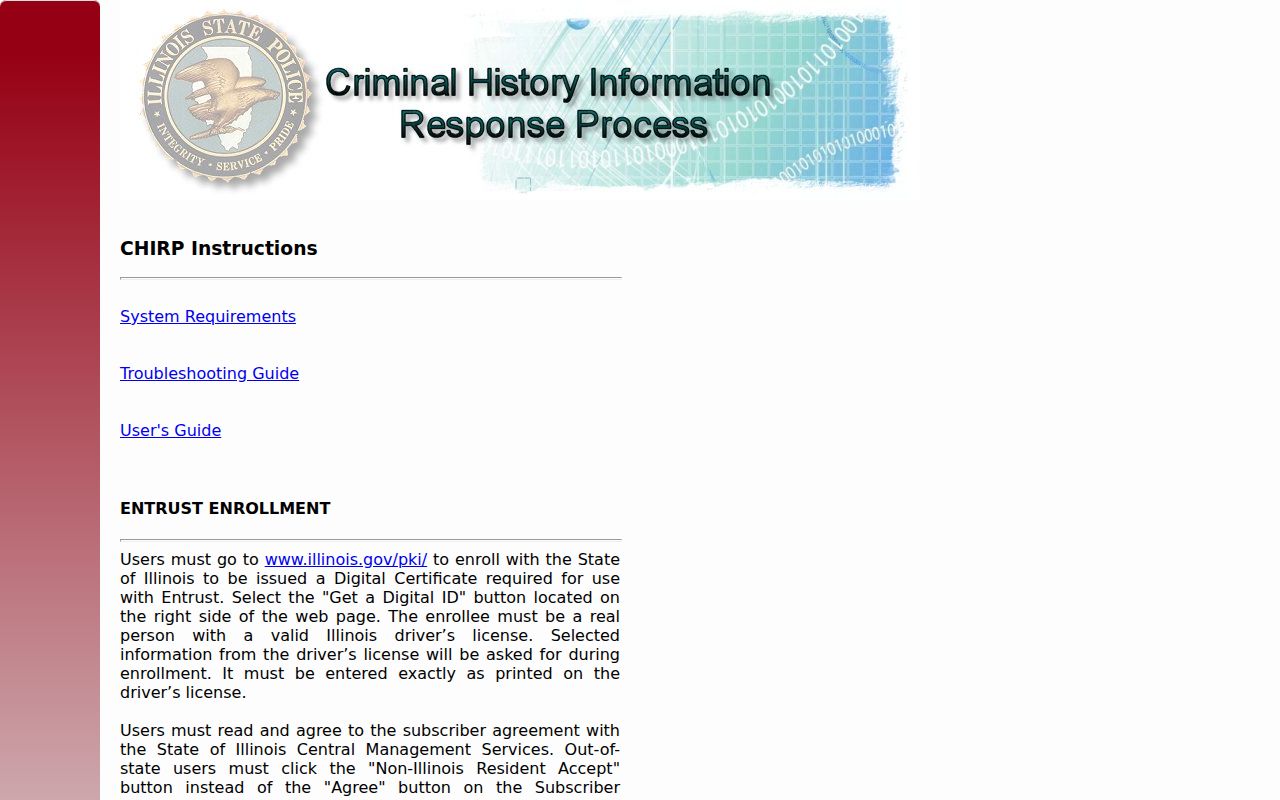
This screen supports the key distinction between an authorized CHIRP inquiry and the paper UCIA fallback for someone without portal access.
The ISP Criminal History page explains the conviction-only scope of public UCIA information.
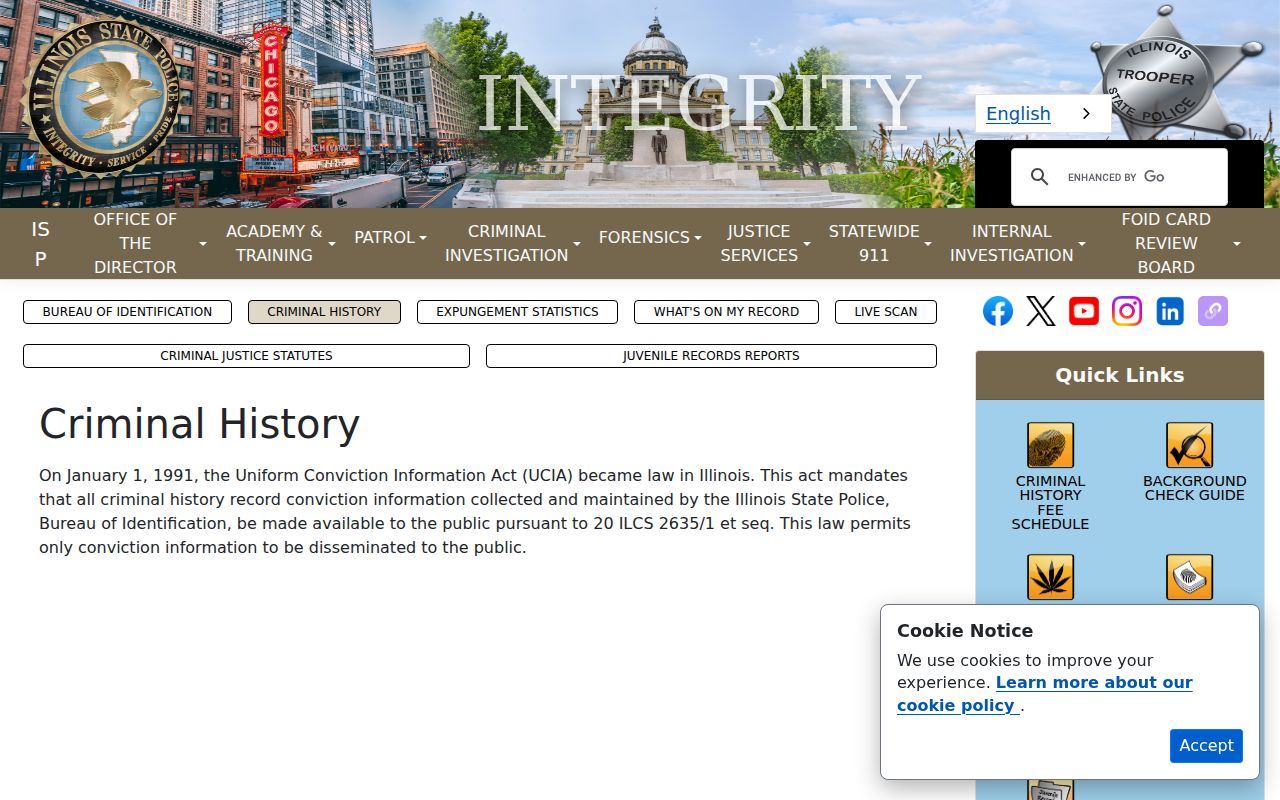
The state explanation helps prevent a public conviction response from being mistaken for every local arrest or dismissed charge.
For self-review, the ISP Access and Review page sets out fingerprint submission and the record-challenge route.
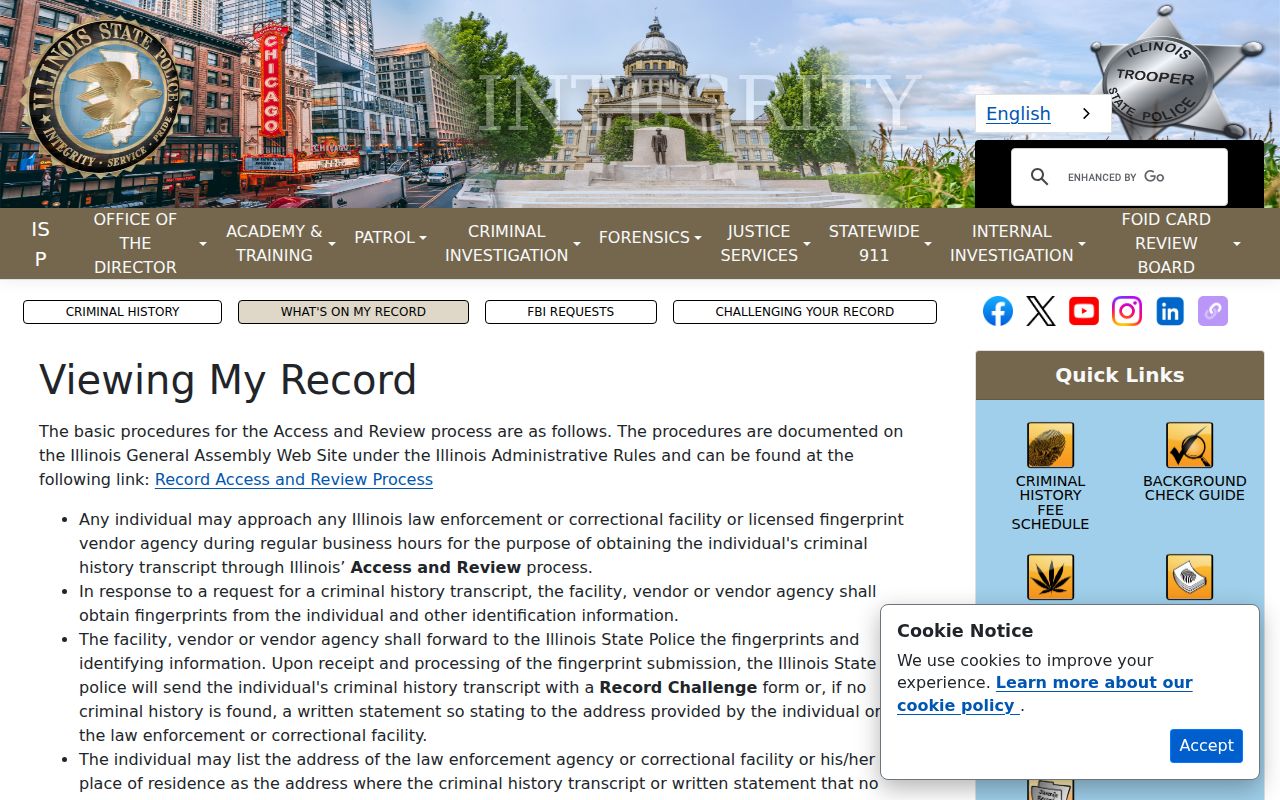
That channel connects a person's own Illinois transcript to a formal correction process when the clerk and repository do not agree.