
Williamson County Criminal Court Cases
Felony and misdemeanor prosecutions in Williamson County go to the Circuit Court of the First Judicial Circuit. Illinois does not divide this work among separate district, county, and justice courts. Traffic and municipal ordinance matters also move through the circuit-court structure. Reviewing courts handle appeals, while federal charges belong to the U.S. District Court for the Southern District of Illinois and will not appear as local Williamson County criminal court cases.
The Williamson County Circuit Clerk receives complaints, informations, indictments, motions, orders, judgments, and sentencing papers. The clerk, rather than the Sheriff or State’s Attorney, is the custodian of the filed court record. That division explains why a police report can describe an event while the Williamson County court case shows a different filed count or no prosecution at all.
Williamson Court Counters by Entrance
The Williamson County Courthouse separates traffic work from other clerk divisions. Traffic is on the first floor through the north public entrance. Nontraffic criminal files are handled on the second floor through the south public entrance. Going to the right side of the building can save a needless trip between counters.
The courthouse is at 200 West Jefferson Street, Marion, Illinois 62959. The clerk is open weekdays from 8:00 a.m. to 4:00 p.m., except state and federal holidays observed by court order. Call (618) 997-1301. Misdemeanor and domestic-violence questions use extension 3445, traffic uses 3426, and expungement or appeal questions use 3432. Records requests may also go to records-backgroundrequest@williamsoncountycc.org.
Williamson County Circuit Clerk
200 West Jefferson Street
Marion, IL 62959
(618) 997-1301
Monday-Friday, 8:00 a.m.-4:00 p.m.
Searching Williamson County Case Records
Start at the official clerk page and follow “View Williamson Co. Case Info.” The clerk-authorized link reaches the participating-court search on Judici. Remote results are a finding aid, not a substitute for a certified Williamson County criminal court file. Exact names and full case numbers are strongest. Use the filing year or case type when the interface offers those controls, and compare enough non-sensitive facts before treating a result as the right person.
- Open the Circuit Clerk page and use its Williamson County case-information link.
- Enter an exact surname and first name, or use the full case number when known.
- Narrow the results by filing year or criminal case type if those filters appear.
- Open the docket, check the parties and court, then read every count through its final disposition.
- Email or visit the clerk for a docket, document image, judgment, or certified copy that is not available remotely.
| Field Label | Type | Required | Notes |
|---|---|---|---|
| Last Name | Text | For name search | Use the exact known spelling. |
| First Name | Text | For name search | Add it to reduce same-name results. |
| Case Number | Text | Alternative | A full number is more precise than a name. |
| Filing Year | Filter | No | Use when the control is exposed. |
| Case Type | Filter | No | Limit results to the relevant criminal category. |
Verify Williamson Criminal Dockets
The Williamson County case search is the fastest remote starting point. It may not expose every document image or restricted entry. Older matters can require archive or counter research. Copy, search, and certification charges were not confirmed in a current official local fee schedule, so ask the clerk about cost before ordering.
The manifest image below comes from that official court-authorized search route.
Its search screen helps locate a docket, but the clerk’s original file controls when accuracy or certification matters.
Inside a Williamson County Case File
A Williamson County criminal court case is richer than a booking entry. It records what the prosecutor chose to file, what happened at each hearing, and how each count ended. Read the docket in date order and then inspect the judgment and sentence. A count can be amended, dismissed, resolved through court supervision, tried, or included in a plea agreement.
| Case Number & Court | Identifies the Williamson County matter, filing year, and circuit court. |
|---|---|
| Charging Document | The complaint, information, or indictment states the accusation filed in court. |
| Docket Entries | A dated list of filings, appearances, motions, and judicial orders. |
| Hearing Dates | Arraignment, pretrial, plea, trial, sentencing, and later review settings. |
| Disposition & Judgment | The result for each count, such as dismissal, acquittal, supervision, or conviction. |
| Sentence & Conditions | Custody, probation, restitution, assessments, and other terms entered by the judge. |
Reading Williamson Criminal Case Terms
Several Illinois terms can change the meaning of a docket. An indictment is an accusation, not proof of guilt. Court supervision withholds a judgment of conviction and may avoid a conviction after successful completion, though the record can remain until lawfully cleared. “Nolle prosequi” means the prosecutor formally declined to proceed on that charge at that time.
- Arraignment
- The hearing where the accused is told the charge and enters a plea.
- Disposition
- The outcome assigned to a count or case.
- Pretrial release
- Release under court-set conditions rather than the old routine cash-bail model.
- Assessment
- A court-imposed financial charge distinct from restitution.
Compare every charge line to its own result. One Williamson County criminal case can contain several counts with different outcomes.
How a Williamson Criminal Case Moves
A local case may begin with an arrest or summons. The State’s Attorney then chooses whether and what to file. Early hearings address counsel and pretrial release or detention. Discovery and motions follow. A plea, bench trial, or jury trial leads to a judgment, then sentencing when there is a conviction. Later entries may show a posttrial motion, appeal, probation issue, or clearing petition.
Case flow: Charges Filed › Arraignment › Pretrial › Plea or Trial › Disposition › Sentencing
The arrest charge, filed charge, and conviction count can differ. For the earlier custody event, use the separate Williamson County arrest lookup channels.
Timing varies with the facts, motions, and trial calendar, so no single local duration should be assumed. The docket is the best timeline. Read the entry text instead of judging progress from the last date alone. A scheduled setting may be continued, a motion may await a ruling, or a negotiated plea may resolve several counts on one day. When a sentence includes probation, the judgment appears in the Williamson County case while detailed supervision material remains with First Circuit Probation.
Williamson Warrant Calendar Trap
First Circuit Local Rule 1.11 creates a local docket trap. When an unserved felony or misdemeanor arrest warrant remains outstanding for six months, the clerk moves the case to a warrant calendar and marks it terminated for statistical purposes. That label does not mean a judge decided the charge. Service of the warrant or a court order restores the case to the active docket.
Each December, the clerk gives the prosecutor and presiding judge a list of warrant-calendar cases older than one year. A person who sees “terminated” should call the proper clerk division and confirm the actual warrant and case status. Online data can lag, and an old list is not proof that a warrant remains active or has cleared.
A bench warrant can follow a missed appearance or alleged violation. An arrest warrant begins a custody process, while a search warrant authorizes a search of a place or item. The public docket may show some warrant activity, but an unserved, sealed, juvenile, or investigation-linked warrant may not be visible remotely. Resolution must run through the issuing court and law enforcement.
Williamson Case Access and Restrictions
First Circuit Local Rule 1.4 makes inspection the usual rule unless a statute or court order restricts the file. Juvenile, adoption, impounded, sealed, and expunged matters are not ordinary public search results. Victim and minor identifiers, financial data, medical facts, and confidential material may also be withheld or redacted. Remote access can be narrower than inspection at the courthouse.
Expungement has a distinct index effect in Williamson County. Local rules say the defendant’s name is removed from the case-number index, “expunged” replaces it, and the physical file is locked and impounded. An old case number can therefore survive after a name search stops returning the person. The Illinois expungement and sealing statute governs eligibility and process.
The official ISP fee page shown below explains state criminal-history charges, which are separate from unverified local copy fees.
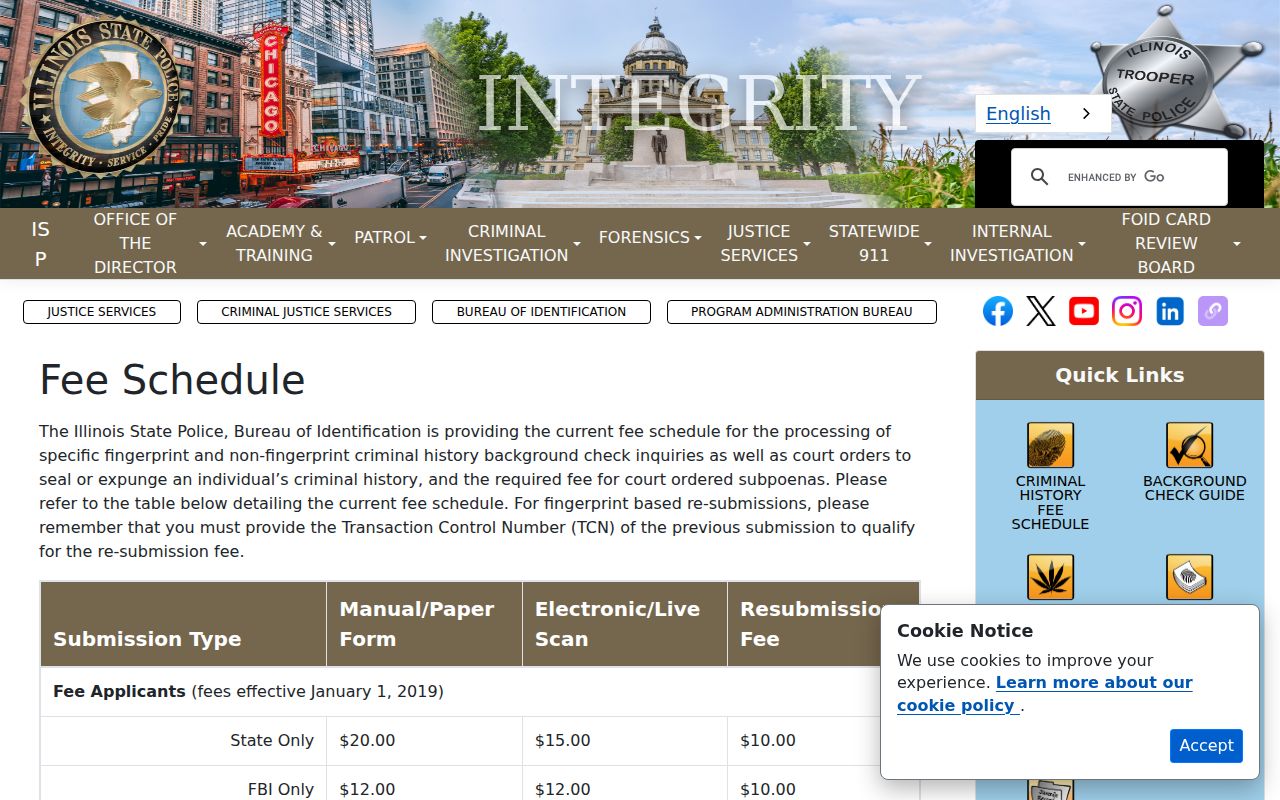
This state fee source helps distinguish an ISP record product from a clerk-issued Williamson County court document.
Illinois FOIA applies to public bodies, but judicial case access follows court rules and the clerk’s process. A county FOIA request is not a shortcut around a sealed or impounded court file. If a Williamson County criminal case does not appear, give the clerk the case number, filing year, name spelling, and type of document sought. Ask whether the issue is an archive search, a remote-access limit, a restriction, or simply a filing delay.